.png)

For hotel guests, fast and secure hotel WiFi has gone from “nice to have” to non-negotiable, especially for business travelers. In fact, according to the Hospitality Technology 2023 Lodging Study, 92% of guests say that a strong WiFi connection is their top priority when booking a hotel. In other words, your hotel’s network is one of your largest revenue drivers, and crucial to providing a top-tier guest experience.
In this post, we’ll be exploring best practices that hotels and resorts can use to strengthen their network and provide reliable property-wide WiFi. For an insider look, we spoke with Trevor Dowswell, Chief Technology Officer at Hotel Internet Services, about the current state of hospitality networks as well as the hospitality network solutions that will be shaping the industry in 2025.
9 Hospitality Network Solutions Best Practices for 2025
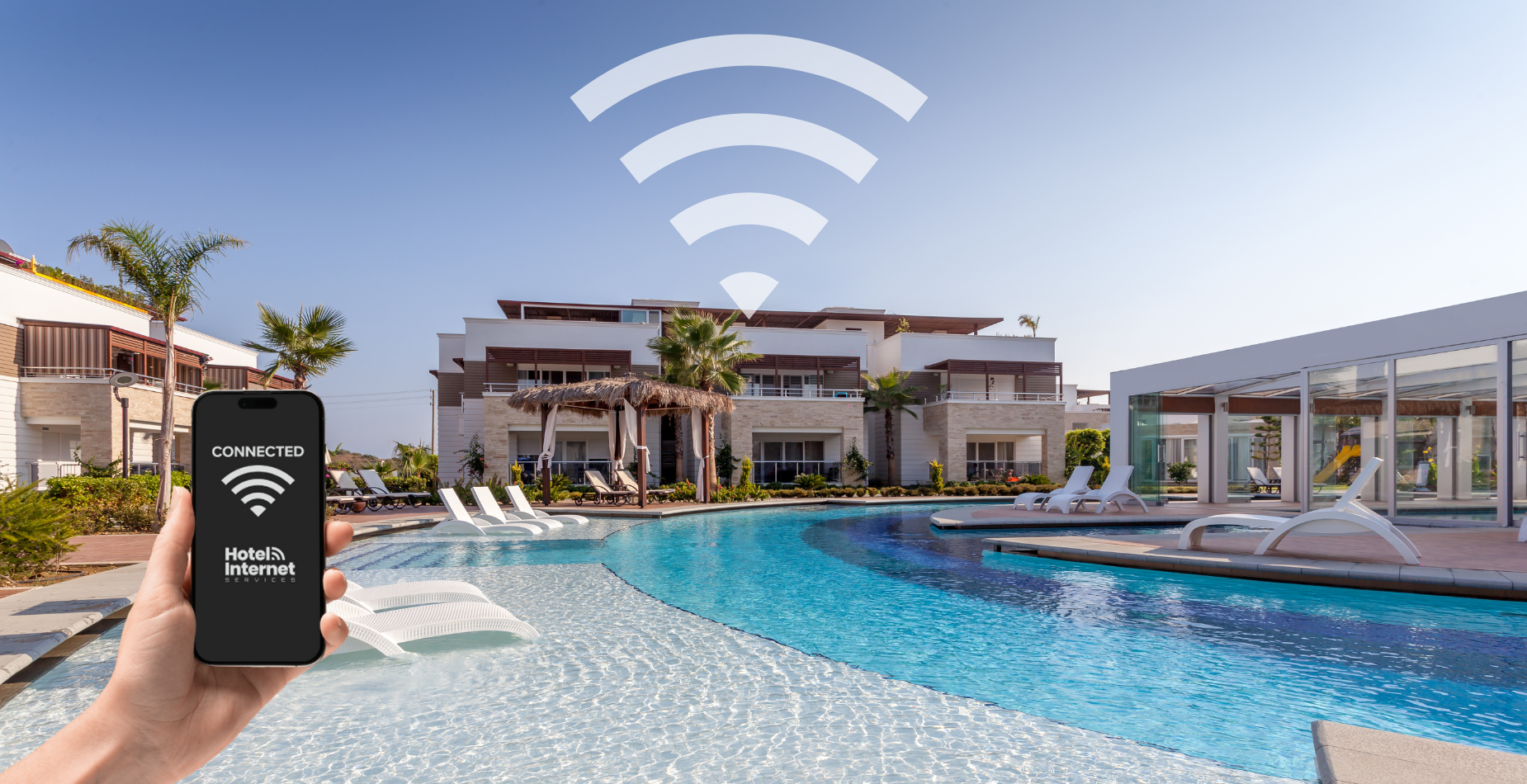
When it comes to WiFi, guests demand speed, security, and reliability. Delivering on those expectations is only possible with a well-designed and well-maintained wireless network.
Luckily, network technology is evolving rapidly, giving hotels and resorts new opportunities to provide outstanding and safe WiFi access to their guests. Below are nine hospitality networking trends that can help hotels and resorts maximize WiFi strength, boost guest satisfaction, and drive revenue in 2025.
 1. Embrace converged networking
The traditional approach to hotel wifi network design has been to separate different networks based on the type of data they carried. For instance, phone lines, guest WiFi, and surveillance camera footage would each operate on separate networks. Such a design is costly and complicated, requiring extensive rewiring if the hotel wants to expand or upgrade its infrastructure.
Nowadays, many hotels are using converged networking, and it’s quickly becoming the standard for hotel wifi network design.
“Converged networking allows hotels and resorts to combine their different networks into a single unified infrastructure,” explains Trevor. “It’s more budget-friendly and fiscally responsible to install one network across an entire property. And today, different systems ranging from phone lines to surveillance cameras all rely on the network, so it makes logistical sense to have them on the same network.”
2. Prioritize security in every part of your system
Adopting converged networking can help hotels save time and reduce costs while offering superior network performance and security for guests. However, it’s vital to prioritize security in every part of a hotel’s converged network — the data network, security footage, phone lines, and so on.
“For a properly functioning converged network, hotel owners and managers need to make sure every part of their infrastructure is tightly secured,” explains Trevor. “Effective segmentation is also essential to maintain separation between all networks that are sharing the same infrastructure.”
This is particularly important because if a hacker gains access to an unsecured part of the network, they could easily infiltrate other connected components. Should guests have their personal data compromised in the process, the breach could result in significant legal and financial consequences.
 3. Use VLANs to keep components isolated
For hotels and resorts using a converged network, properly isolating the different pieces of a property’s wireless infrastructure is critical. Otherwise, a user could gain access to the guest WiFi network and compromise other systems, such as the property management system, servers containing credit card data, the phone system, and other resources operating on that network.
“The solution is to use a virtual local area network, or VLAN, to securely run multiple networks over the same physical wiring,” says Trevor.
Don’t let the technical term intimidate you. In this context, Trevor explains, “virtual” means that the separation of networks is achieved through software configuration rather than physical hardware. VLANs are a way to set up what are effectively separate networks that run on the same physical wires or WiFi channels, creating segmentation not physically but virtually.
“A hotel should use VLANs to ensure systems like guest WiFi, staff WiFi, phone lines, and security cameras are logically separated into their own secured networks,” says Trevor. “This prevents unauthorized access between systems and allows for specific access controls on each network.”
4. Make sure you have backup plan
Any system can fail, and hotel wifi networks are no exception. In the event that a property’s network goes down, there should be a backup plan so guests don’t lose service, which could lead to poor reviews and lost future revenue.
“For hotels, this usually means having two internet lines as part of a redundant system,” explains Trevor. “That way, if one provider fails, the property can switch to the other line so guests and hotel staff won’t lose their WiFi connection.”
5. Provide ample bandwidth for all users
With hundreds of guests using the internet at the same time, it’s not difficult to see how a hotel WiFi network could get strained and lose performance quality. That’s why it’s important to supply enough bandwidth for all guests to maintain a reliable and high-speed internet connection.
“The last thing hotels want is for guests to have poor internet service,” says Trevor. “If a family of four is staying in your hotel, you could have four people each watching a different Netflix movie on their phones. Multiply that by every room in your hotel, and you start to see why bandwidth is such a big deal.”
As technology gets more sophisticated and internet use keeps growing, hotels need more and more bandwidth to keep up. Partnering with a hotel internet services provider ensures your WiFi network delivers the performance guests expect.
 6. Monitor for abuse and take action when needed
Unfortunately, there’s always the possibility that a guest will use your network for illegal activities. Just as often, guests may unknowingly bring devices infected with malware that hijacks the device’s resources and network connectivity for its own ill-intended purposes.
“There are two main reasons it’s a good idea to monitor for illegal activities and network abuse,” says Trevor. “The first is that you don’t want your network flagged and shut down for illegal activity. The second is that spamming and other cyber attacks take a huge amount of bandwidth, so the hotel is essentially paying for someone else’s illegal activities.”
This makes it important for hotels to monitor for abuse on their networks and take action when needed. See the section below on internet gateways for solutions to help detect and mitigate such threats in real-time.
7. Don’t forget basic security steps like updates and 2-factor authentication
Hotels also need to follow security best practices to make sure that only approved staff members can change network security configurations.
Without this level of control, even the most robust security measures can be compromised by unauthorized changes.
“Hotels need to keep their firmware up to date, use two-factor authentication (2FA) to keep unauthorized users out, and install security patches whenever they become available,” says Trevor. “These may seem like obvious points, but many hoteliers forget about them and end up regretting it.”
 8. Use access controls to keep bad actors out
Robust access controls are an essential part of a well-designed hotel WiFi network. If your system lacks access controls, anyone on your property can sign on and use your network for nefarious or illegal purposes.
“The way to fix that unrestricted network access is with some kind of authentication mechanism that uses login credentials to restrict guest network usage to hotel guests and authorized visitors,” explains Trevor. “Typically, using the guest’s last name and room number for their network password is secure enough, and much simpler for people to remember than a random code.”
9. Consider an internet gateway as your network multitool
An internet gateway is a device that connects different networks on a property, allowing them to exchange information and communicate with each other. A well-designed internet gateway can handle almost every element discussed above, offering access controls, security features, bandwidth management, and other functions in one device.
For example, the FUSION Gateway integrates hotel network solutions into a single unit, providing real-time network monitoring and tracking for every device using the internet on a hotel’s property. “It will detect if a computer comes on and opens up a large number of connections to the internet without authorization, and automatically limit their network consumption to avoid any negative affects, or even block the user entirely if their activity is deemed illegal or designed to disrupt or degrade the internet service,” says Trevor.
As Trevor explains, when suspicious activity is detected on a network, the internet gateway will trigger a pop-up window notifying them that their device has been flagged due to an abnormal number of connections to the internet without authorization.
“Not only does this make hotel networks more secure, but guests appreciate it as well. A lot of the time, they have no idea that their phone has been infected with spamware,” says Trevor.
The Future of Hospitality Network Solutions
Ultimately, all of the hospitality network solutions we’ve explored in this article — from converged networking and VLANs to network monitoring, internet gateways, and more — are aimed at creating a reliable, secure, and high-performance network infrastructure. By implementing these solutions, hotels can ensure their networks not only meet the demands of today’s guests but also provide a foundation for future advancements and increasing connectivity demands.
HIS has been a leading provider of high-speed internet access, next-generation communications, and in-room entertainment technology for more than 17 years. With our GuestCastTV Casting entertainment solution and hospitality WiFi solutions, NetCore Systems offers cutting-edge connectivity solutions to help hotels stay up to date with the latest revenue-boosting trends. Contact us today to learn more.